Data contracts have become one of the most practical ways to reduce instability in modern analytics platforms. As warehouses absorb information from APIs, event streams, SaaS platforms, operational databases, and internal applications, even a small upstream change can ripple through dashboards, machine learning features, and financial reporting pipelines.
A renamed column. A timestamp format change. A new enum value that nobody documented.
Small changes often create expensive downstream failures.
That is where data contracts enter the picture. A data contract defines the structure, quality expectations, and delivery guarantees of data moving from source systems into the warehouse. Instead of relying on assumptions, producers and consumers work against a clearly defined agreement.
Large-scale streaming platforms popularized this approach years ago through technologies like schema registries, but the concept has expanded far beyond Kafka ecosystems. Today, warehouses, lakehouses, and analytics engineering workflows increasingly rely on contract-driven ingestion patterns.
Quietly, this has changed how modern data platforms are designed.
What Data Contracts Define
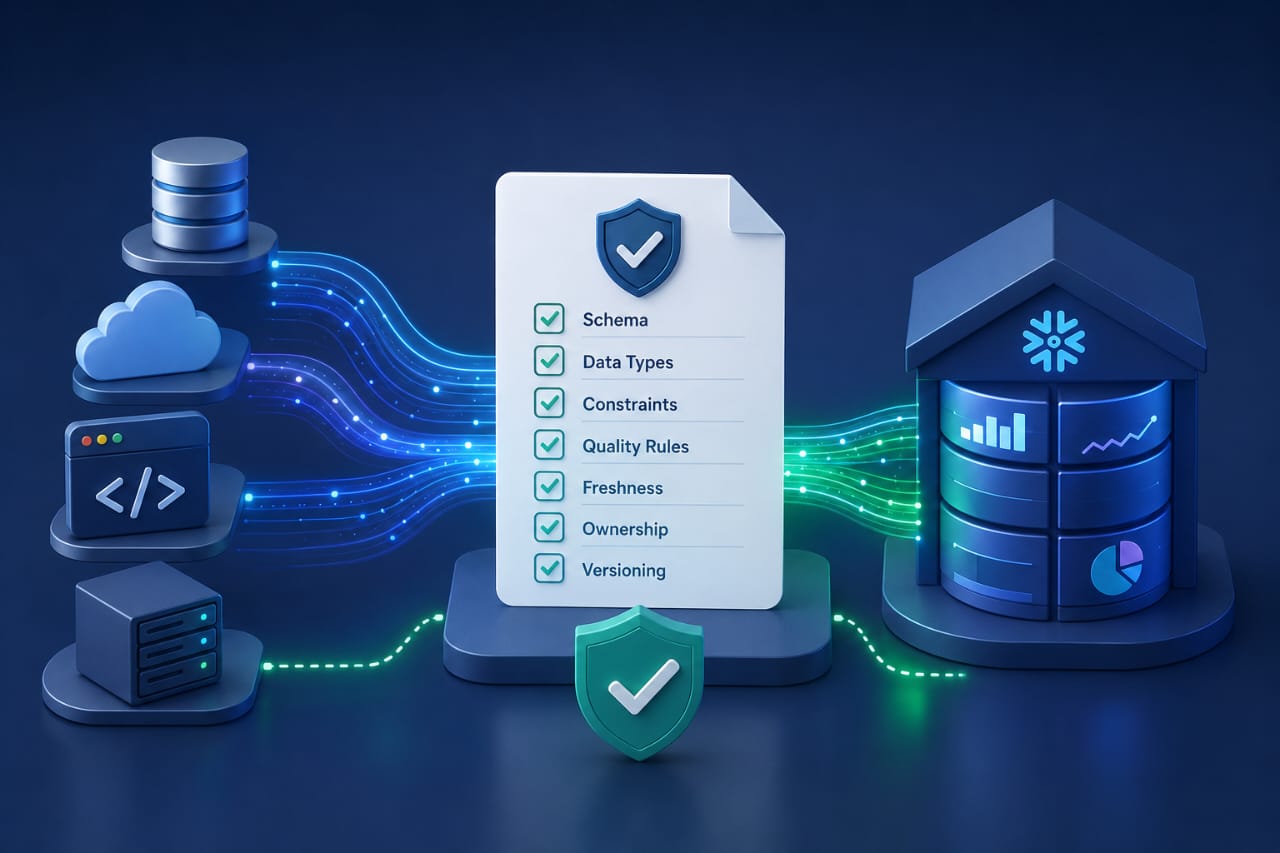
A data contract describes what data should look like before it enters the warehouse. The agreement is usually machine-readable and version-controlled.
A contract may include:
- Field names and data types
- Required and optional columns
- Accepted value ranges
- Freshness expectations
- Null handling rules
- Schema evolution policies
- Ownership information
- Backward compatibility rules
For example, an order pipeline may define order_total as a decimal value greater than zero, while status may only accept approved states such as pending, shipped, or cancelled.
Without those controls, warehouses become vulnerable to silent corruption. Data still loads successfully, but reporting logic slowly drifts away from reality.
IBM’s overview of data contracts compares this evolution to the standardization APIs introduced into software engineering.
How Data Contracts Reduce Warehouse Failures
Most warehouse failures do not begin inside the warehouse itself, they begin upstream.
An application developer changes a field type. A SaaS vendor modifies an API response. A logging pipeline introduces inconsistent timestamps. An ingestion connector automatically evolves the schema without validation.
The warehouse accepts the data, the damage appears later.
This pattern became common after ELT workflows replaced tightly controlled ETL pipelines. Warehouses became easier to scale, but governance moved closer to the ingestion layer.
Data contracts restore structure by validating incoming data before downstream systems depend on it.
Modern observability platforms such as Monte Carlo now focus heavily on contract validation because schema drift remains one of the most persistent reliability issues in analytics infrastructure.
Data Contracts and Schema Evolution
Schema evolution is where most contract discussions become practical.
Some schema changes are relatively safe:
- Adding nullable columns
- Adding optional metadata fields
- Expanding accepted enum values carefully
Other changes are far more disruptive:
- Renaming columns
- Deleting existing fields
- Changing integer fields into strings
- Changing timestamp formats
- Repurposing existing columns for different business meanings
One of the most dangerous situations happens when a column keeps the same name but changes semantic meaning.
For example:
amount
Originally, the field represents order subtotal.
Months later, it suddenly includes tax and discounts.
No schema violation occurs.
Yet revenue reporting changes overnight.
This is one reason modern contracts increasingly include business-level validation rather than basic datatype checks alone.
How to Implement Data Contracts Between Source Systems and the Warehouse
Strong implementations usually begin with ingestion rather than warehouse modeling.
That distinction changes everything.
If invalid data reaches curated warehouse layers before validation occurs, downstream recovery becomes much harder.
A practical implementation process often looks like this:
1. Define Contracts Close to the Source
The source application should publish the expected schema and delivery rules.
Common formats include:
- JSON Schema
- Avro
- Protobuf
- YAML-based specifications
Streaming ecosystems commonly use Confluent Schema Registry to enforce compatibility between producers and consumers.
2. Validate Before Warehouse Ingestion
Validation should occur before data lands in curated warehouse tables.
Typical validation checks include:
- Required field validation
- Datatype verification
- Accepted enum values
- Freshness thresholds
- Duplicate detection
- Null percentage thresholds
Failed records can be quarantined into dead-letter queues or isolated staging areas for inspection.
This creates a controlled failure boundary.
3. Introduce Versioning Rules
Contracts should evolve predictably.
A common strategy includes:
- Allow additive nullable fields
- Reject destructive schema changes
- Require version bumps for breaking changes
- Preserve backward compatibility whenever possible
This prevents downstream systems from breaking unexpectedly after deployments.
4. Separate Raw and Curated Layers
Raw ingestion should remain immutable.
This allows replaying historical data if validation rules change later.
Lakehouse architectures often organize this using bronze, silver, and gold layers, where stricter quality guarantees apply as data moves closer to analytics consumption.
Databricks documents this layered architecture extensively for large-scale pipelines.
The Organizational Side of Data Contracts
Technical validation is only part of the equation.
Ownership is equally important.
Many warehouse incidents happen because upstream application developers do not realize analytics systems depend on certain fields. At the same time, analysts often assume schemas are stable even when no guarantees exist.
Data contracts introduce explicit accountability.
Every dataset should clearly identify:
- Who owns the source
- Escalation contacts
- Delivery expectations
- Version history
- Approved schema evolution rules
Once ownership becomes visible, debugging becomes significantly faster.
So does recovery.
Where Data Contracts Struggle
Not every problem can be solved through schema validation.
Semantic consistency remains difficult.
A field may technically satisfy the contract while still containing misleading business information.
For example, a payment status may appear valid even though associated timestamps are missing or logically inconsistent.
This is where observability tooling, lineage tracking, and business-rule validation become increasingly important.
Projects like OpenLineage continue pushing deeper visibility into how datasets move across modern platforms.
The Shift Happening Inside Modern Warehouses
Warehouses are no longer passive storage layers.
They increasingly operate as shared operational systems supporting analytics, automation, forecasting, machine learning, and customer-facing applications.
That shift has changed expectations around reliability.
Tables now behave more like interfaces.
Datasets behave more like products.
And ingestion pipelines increasingly behave like production infrastructure.
Data contracts fit naturally into that transition because they establish predictable boundaries between systems that evolve independently.
Not through assumptions.
Through enforceable agreements.
As warehouse ecosystems continue expanding across streaming, AI, and real-time analytics environments, contract-driven ingestion is likely to become standard practice rather than an advanced architecture pattern reserved for large platforms.