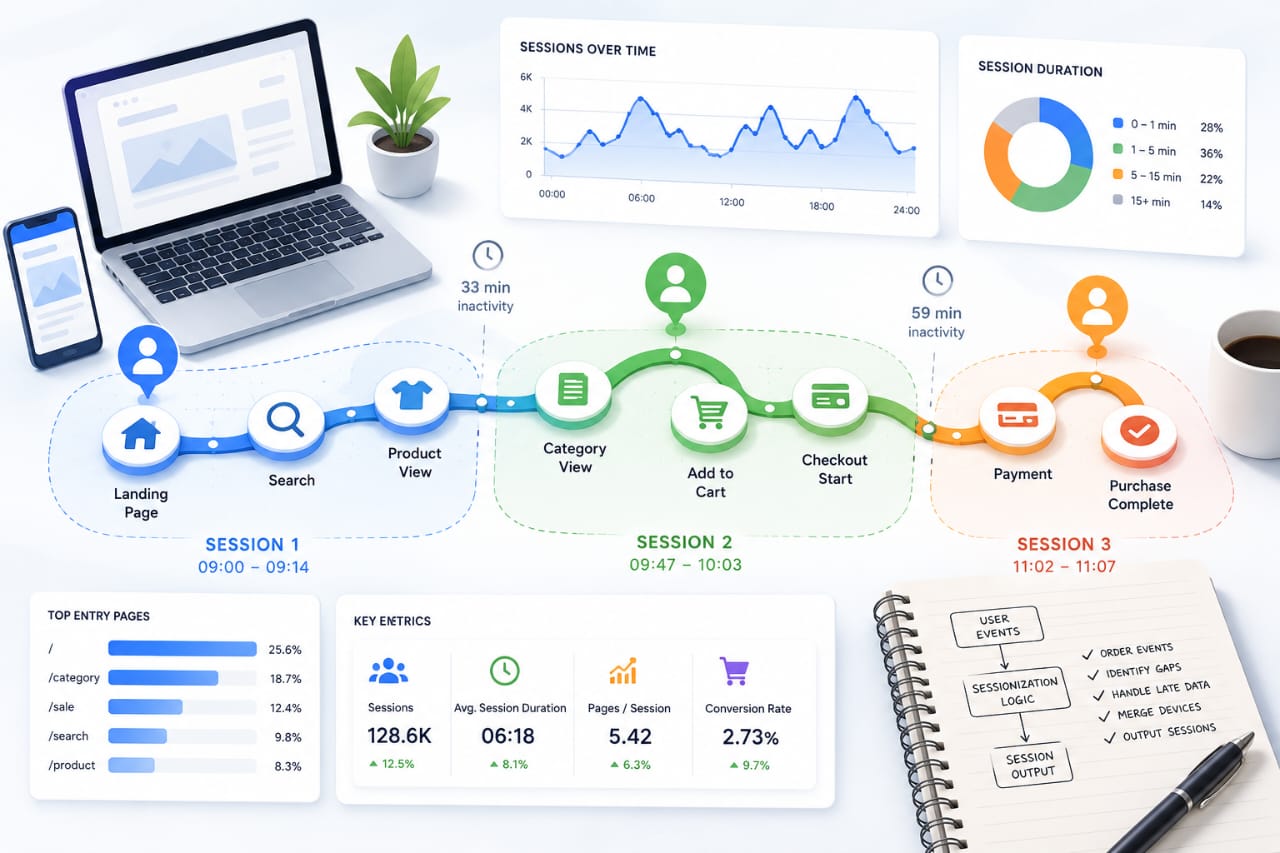
Sessionization strategies are easy to explain on whiteboards and surprisingly difficult to get right in production. Most articles reduce the topic to “group events within 30 minutes,” but that logic starts breaking the moment traffic becomes distributed across mobile apps, unstable networks, multiple devices, and delayed event streams.
In one ecommerce pipeline I audited, nearly 18% of purchase events were being attached to the wrong sessions because mobile reconnects caused checkout events to arrive before product views. Revenue attribution looked healthy in dashboards. The underlying data was quietly corrupted.
That kind of issue is more common than most analytics dashboards admit.
Clickstream analysis depends heavily on how sessions are constructed. Session boundaries influence conversion attribution, recommendation systems, retention metrics, fraud detection, engagement scoring, and customer journey modeling. Once sessionization logic drifts away from actual user behavior, every downstream metric becomes less trustworthy.
Most Sessionization Strategies Still Depend on Inactivity Windows
The standard model remains simple:
current_event_time - previous_event_time > thresholdIf the inactivity gap exceeds the configured threshold, a new session begins.
The 30-minute timeout became common largely because early analytics platforms needed a practical default rather than a scientifically accurate boundary. SAS documentation on clickstream sessionization still reflects how deeply this model is embedded into enterprise analytics tooling.
For small systems, inactivity windows work reasonably well. At scale, they become fragile.
Users pause videos for an hour. Mobile operating systems suspend applications unpredictably. Tabs remain open overnight. Users jump between desktop and mobile sessions constantly. Some browsers aggressively throttle background network requests. All of this creates false session boundaries.
How Sessionization Strategies Fail in Streaming Pipelines
Batch warehouse processing hides many problems because events are already ordered before analysis begins. Real-time systems do not have that luxury.
Modern clickstream infrastructure often looks something like this:
Client SDKs
    ↓
Kafka
    ↓
Flink or Spark Streaming
    ↓
Sessionization Layer
    ↓
Feature Store / Warehouse
    ↓
Analytics and ML Models
The moment event streams become distributed, sessionization becomes a state-management problem rather than a simple SQL exercise.
Each active user session may require continuously updated state containing:
{
  session_id,
  last_event_time,
  campaign_source,
  device_id,
  engagement_score,
  event_count
}
At high traffic volumes, state growth becomes expensive very quickly.
I have seen Flink jobs remain healthy for weeks before collapsing after a marketing campaign suddenly tripled concurrent session counts. The checkpointing layer became saturated, watermark progress stalled, and downstream dashboards began lagging by nearly forty minutes.
The sessionization logic itself was technically correct. The infrastructure around it was not prepared for the state explosion.
Apache Flink’s session window documentation explains how dynamic session windows expand until inactivity thresholds are exceeded, but production behavior becomes far more complicated once millions of active windows exist simultaneously.
Out-of-Order Events Quietly Corrupt Clickstream Analysis
This is where many analytics systems start producing misleading data. Real user events rarely arrive in chronological order.
Mobile applications buffer events during poor connectivity. Retry mechanisms duplicate requests. CDN edges introduce latency variance. Background synchronization delays uploads.
A common failure pattern looks like this:
08:02 — User views product
08:05 — User adds to cart
08:11 — User purchases item

Actual arrival order:

08:11 purchase arrives first
08:02 product view arrives later
08:05 add-to-cart arrives last
Naive pipelines often create separate sessions entirely.
Suddenly the analytics platform reports direct conversions with no customer journey.
Marketing attribution becomes unreliable almost immediately.
Good streaming systems handle this using event-time processing and watermarking rather than ingestion timestamps. Confluent’s guide to session windows provides a strong explanation of how streaming platforms maintain session continuity while tolerating late-arriving data. Even then, tradeoffs remain unavoidable.
Allowing very late events improves accuracy but increases memory pressure and state retention costs. Aggressive watermarking lowers infrastructure overhead but risks permanently dropping delayed events. There is no universally correct configuration.
Identity Resolution Is Still an Unsolved Problem
Many clickstream discussions pretend sessionization begins after user identity has already been established. That assumption falls apart quickly in real systems.
Cookie expiration policies, privacy restrictions, browser isolation features, VPN usage, and cross-device browsing continuously fragment user identity. Most organizations overestimate how accurate their identity stitching actually is.
A retailer may believe a user completed a conversion journey across desktop and mobile sessions when, in reality, probabilistic identity matching linked two unrelated users sharing the same household IP range. The reverse problem is equally common.
The same user appears as four separate visitors because authentication occurred too late in the funnel.
Identity-aware sessionization typically combines:
- authenticated accounts
- first-party cookies
- device fingerprints
- behavioral similarity scoring
- cross-device linkage graphs
Even sophisticated customer data platforms struggle once deterministic identifiers disappear.
The quality of sessionization is often constrained more by identity fragmentation than by session window logic itself.
SQL Sessionization Works Longer Than Most Engineers Expect
There is a tendency to overcomplicate clickstream infrastructure too early.
Many organizations jump directly into Kafka and Flink pipelines when a properly indexed warehouse could comfortably process their workload for years.
Warehouse sessionization using SQL window functions remains surprisingly effective at moderate scale.
A standard implementation usually relies on LAG() comparisons:
WITH ordered AS (
  SELECT
    user_id,
    event_time,
    LAG(event_time) OVER (
      PARTITION BY user_id
      ORDER BY event_time
    ) AS prev_time
  FROM events
)

SELECT *,
  CASE
    WHEN TIMESTAMPDIFF(
      MINUTE,
      prev_time,
      event_time
    ) > 30
    THEN 1
    ELSE 0
  END AS new_session
FROM ordered;
Platforms such as BigQuery, Snowflake, ClickHouse, and Redshift handle this efficiently until event cardinality and concurrency become extremely large. The operational simplicity is often underrated.
Streaming architectures introduce continuous debugging overhead:
- checkpoint corruption
- consumer lag
- state recovery failures
- backpressure
- late-event replay logic
Many data platforms adopt streaming long before the business genuinely needs sub-second behavioral processing. That decision becomes expensive later.
Behavioral Sessionization Is Replacing Static Time Windows
Some modern analytics systems are moving away from rigid inactivity thresholds entirely.
Instead of asking whether enough time has passed, behavioral models evaluate whether user intent has changed.
Signals may include:
- scroll depth
- cursor velocity
- navigation entropy
- interaction cadence
- device transitions
- dwell variance
A user researching enterprise databases for forty minutes likely belongs to the same analytical session even with long inactivity gaps. A sudden switch into unrelated product categories may indicate a completely different behavioral objective despite minimal elapsed time.
This style of clickstream analysis is increasingly tied to recommendation systems, fraud detection, adaptive search ranking, and personalization engines. It also introduces another layer of complexity.
Machine learning-driven sessionization can become extremely difficult to debug because session boundaries are no longer deterministic. Analysts may struggle to explain why two identical-looking journeys were segmented differently. Interpretability becomes a real operational issue.
What Strong Sessionization Pipelines Usually Get Right
Reliable systems generally share several characteristics:
- event-time processing instead of ingestion-time ordering
- late-event tolerance policies
- deduplication before aggregation
- raw event retention for replayability
- state checkpointing and recovery planning
- continuous monitoring for session anomalies
Raw event retention is especially important. Sessionization logic almost always changes over time. Rebuilding historical sessions becomes impossible once only aggregates remain.
That mistake has trapped more than a few analytics platforms inside inaccurate attribution models they could no longer reconstruct properly.
Sessionization sounds deceptively simple. In practice, it becomes one of the easiest ways to quietly poison clickstream analytics at scale.