What if the future of artificial intelligence isn’t in massive data centers, but in the device you’re holding right now?
For years, cloud computing has been the backbone of modern AI. Every chatbot response, image generation request, or voice command typically involved sending data to powerful remote servers for processing. That model is still important, but the industry is undergoing a noticeable shift. Increasingly, AI workloads are moving closer to users by running directly on smartphones, laptops, wearables, and other edge devices.
This isn’t simply another technology trend. It’s a practical response to growing concerns about privacy, speed, connectivity, and the rising cost of operating large-scale AI services. Major technology companies including Apple, Google, Microsoft, Qualcomm, Intel, AMD, and Samsung are investing heavily in dedicated AI hardware and software designed to make local processing a core part of future devices.
Privacy is Becoming a Deciding Factor
One of the biggest drivers behind on-device AI is privacy. When AI models run locally, sensitive information such as messages, documents, photos, or voice recordings can often be processed without leaving the user’s device.
Apple has made this approach central to its AI strategy through Apple Intelligence, combining local processing with its Private Cloud Compute system only when more complex tasks require additional computing resources. Apple says this architecture minimizes unnecessary data sharing while maintaining strong privacy protections.
The company has also published technical documentation explaining how its foundation models operate across on-device and cloud environments. See Apple’s Apple Intelligence Foundation Language Models Tech Report and its overview of third-generation foundation models for more details.
For businesses operating in regulated industries such as healthcare, finance, and government, keeping more data on local devices can simplify compliance while reducing exposure to external risks.
Faster Responses Without Depending on the Cloud
Speed is another compelling reason. Cloud-based AI always depends on network quality, internet availability, and server capacity. Even small delays become noticeable during conversations with voice assistants or while using live translation and image editing tools.
Running AI models locally eliminates much of that waiting time. Tasks such as text summarization, voice recognition, writing assistance, and smart photo search can happen almost instantly because the data never needs to travel across the internet.
Google’s Gemini Nano and Apple’s on-device foundation models reflect this broader industry direction, where devices increasingly handle everyday AI tasks themselves while reserving cloud infrastructure for more demanding requests.
Offline Intelligence is Becoming an Expectation
Reliable internet access cannot always be guaranteed. Travelers, remote workers, commuters, and emergency responders often find themselves in areas with poor connectivity.
On-device AI allows features such as speech transcription, language translation, note summarization, and image classification to continue functioning without an active internet connection. That reliability is becoming an important selling point as users expect AI to work wherever they are.
Specialized AI Hardware is Changing the Equation
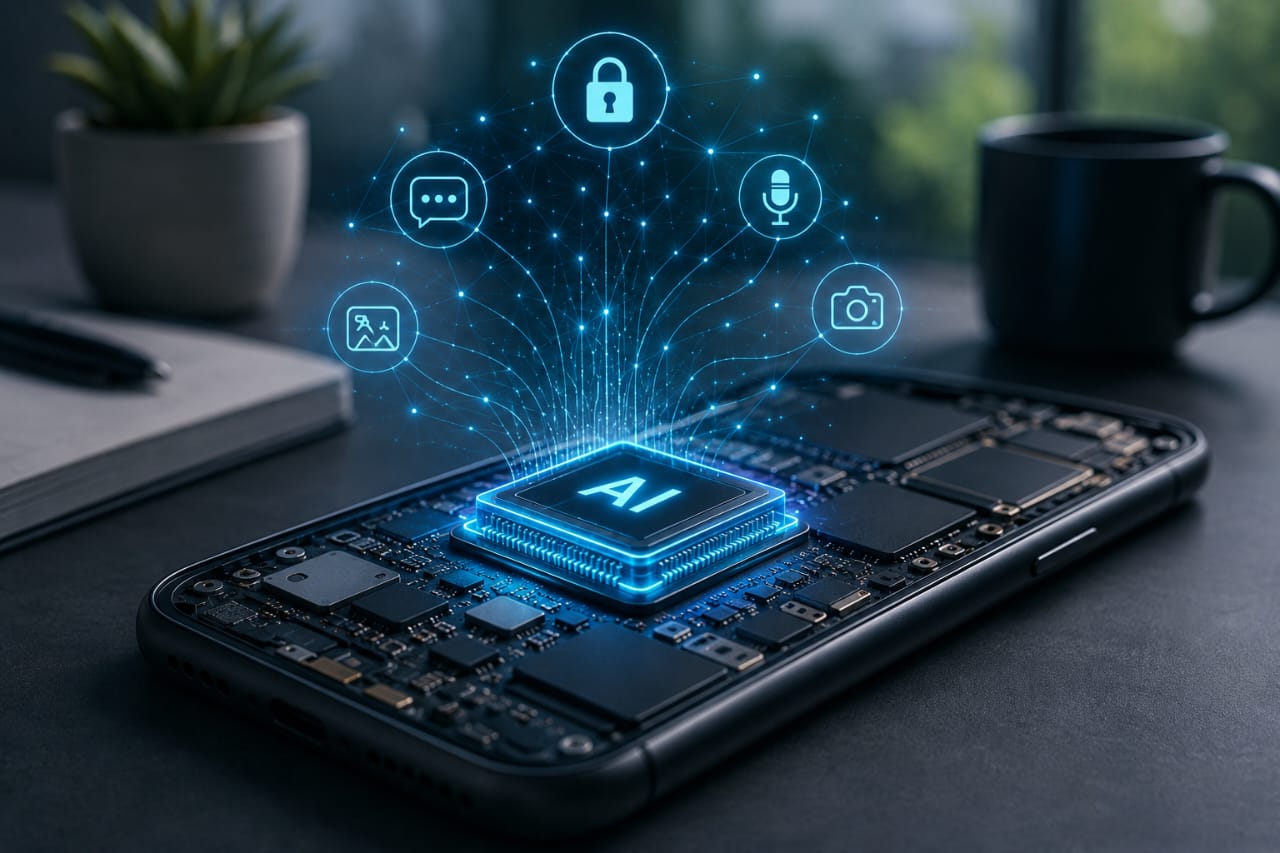
Hardware has evolved rapidly over the past few years. Today’s premium smartphones and AI PCs increasingly include Neural Processing Units (NPUs) or dedicated AI accelerators designed specifically for machine learning workloads.
Unlike traditional CPUs or GPUs, NPUs perform AI operations more efficiently while consuming less power. As a result, manufacturers now advertise AI performance using measurements such as trillions of operations per second (TOPS), highlighting local AI capability as a key product feature rather than a niche specification.
Microsoft has also positioned NPUs as a defining characteristic of modern AI PCs, reflecting how hardware design is adapting to support increasingly sophisticated local AI experiences.
Smaller Models are Becoming Remarkably Capable
Another reason on-device AI is advancing so quickly is that AI models themselves have become more efficient.
Researchers have introduced techniques such as quantization, model distillation, sparse computation, and improved memory optimization. These methods significantly reduce computational requirements while maintaining much of the performance users expect from larger models.
Apple’s latest research describes architectural improvements including quantization-aware training and memory optimizations that enable powerful multilingual models to operate efficiently on consumer hardware. Its technical report provides a detailed explanation of these optimizations.
Reducing the Growing Cost of AI
Cloud AI is expensive to operate. Every request consumes GPU resources, electricity, cooling, storage, and network bandwidth. As millions of users interact with AI services daily, those operational costs continue to rise.
Allowing devices to handle routine inference locally reduces demand on cloud infrastructure while still delivering responsive AI experiences. Rather than replacing cloud computing, this approach distributes workloads more efficiently between user devices and centralized servers.
A Hybrid Future is Taking Shape
Perhaps the strongest evidence that on-device AI is here to stay is that the industry’s largest companies are no longer treating local and cloud AI as competing approaches.
Instead, they are building hybrid systems.
Simple, privacy-sensitive, and real-time tasks are increasingly handled directly on devices. More complex reasoning, larger context windows, and computationally intensive requests continue to run in the cloud. Apple’s evolving architecture reflects this model by combining local foundation models with Private Cloud Compute whenever additional processing power is required.
What Comes Next?
On-device AI is also expanding well beyond smartphones. AI-powered laptops, autonomous vehicles, industrial robots, smart cameras, medical devices, and Internet of Things (IoT) systems all benefit from processing data locally, especially when low latency or continuous connectivity is essential.
There are still challenges to overcome. Local devices have limited memory, battery capacity, and thermal constraints compared to large cloud servers. As a result, the most demanding AI applications will continue to rely on cloud infrastructure for the foreseeable future.
Even so, the momentum is unmistakable. Improvements in AI hardware, more efficient foundation models, stronger privacy expectations, and lower operating costs are all pushing the industry toward a future where intelligent devices do far more processing on their own.
Final Thoughts
On-device AI is gaining momentum because it addresses real-world needs rather than chasing technological novelty. It offers faster responses, better privacy, offline functionality, and a more efficient balance between local hardware and cloud computing.
Instead of replacing cloud AI, it complements it, creating systems that are more responsive, more secure, and better suited to everyday use. As AI becomes a standard feature across consumer and enterprise devices, local intelligence is likely to become just as important as the cloud services that support it.